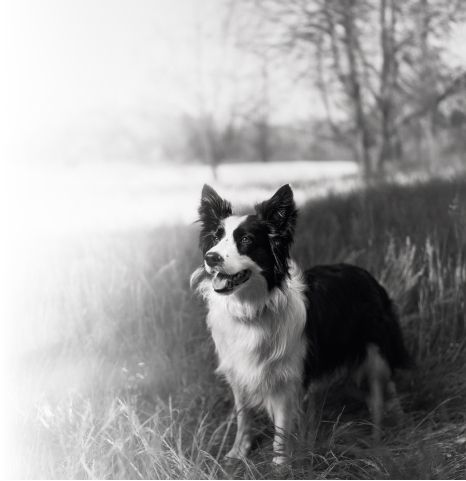

At Man’s side for millenia, the dog has adapted, but he has behavioral and nutritional requirements of his own. Knowing them and respecting them will guarantee his well-being and his health.

The cat’s feline nature is always a matter of fascination. He adapts with apparent ease to daily life, and yet he has behavioral and nutritional requirements of his own. Knowing them and respecting them will guarantee his well-being and his health.

Because of its composition, a Royal Canin Health Nutrition food provides all essential nutrients measured out with utmost precision in order to contribute every day and on a long-term basis to the well-being and health of every animal, according to his age, his size, his physiological condition and his breed.

Innovation for the sake of dogs and cats’ health. For over 40 years, Royal Canin has worked with breeder partners and veterinary nutritionists to go ever further into innovation and precision to enable us to formulate nutritional solutions which perfectly meet dogs and cats’ real needs.

Living with your kitten

Maintaining his health

Simple moves, regularly practiced, for his well-being and his health

The kitten must receive regular hygiene care that maintains his health. These simple gestures ensure his well-being and create moments of closeness, once the first fears have dissipated.

Print Send to a friend aA+ Aa-

If he has been well socialized, an adopted kitten more than eight weeks old is already used to being handled. Nevertheless, one may be afraid of one’s own clumsiness if one has to part his jaws or clip his claws. At first, the animal himself may prove to be too restless. However, short sessions, gentle and repeated, will very quickly make this ritual moment easier. Indeed, even though the cat is a very clean animal, he must be given regularly some hygiene care throughout his life to maintain his health.

Glossy hair

A maintained coat means hair that’s brushed and rid of all dead hairs. He’ll be all the more beautiful for that. With long hair, such as the Persian’s hair, care is compulsory and to be done daily. Hair must be untangled with a comb and then brushed and aired. On short and flat hair, such as that of the Siamese or the Abyssinian, strokes of the hand are all that’s needed. Passing a soft brush every week is required for medium-length hair such as that of the Maine Coon or of the Burmese Sacred Cat. The same goes for a short-haired coat with underhair, such as that of the Exotic Shorthair.

Things to keep an eye on

Impurities may build up in the inside corner of the eye, especially in the Persian. These are to be cleaned up gently with a compress moistened with a lotion reserved for that use. He should have neither runny eyes, nor a runny nose.

You’d better get him used at a very young age to this gesture recommended for proper buccodental hygiene: toothbrushing which limits plaque formation. To do so, you may pass a folded compress on his teeth.

Ear pavilions should not shelter dirt of any kind. If need be, a compress or some cotton moistened with a special lotion will get rid of it. Cotton buds should not be used.

Claws

Blunting the kitten’s claws is in no way a mutilation. On the contrary, this has the advantage of diminishing possible scratching by a cat living indoors. To achieve this easily, the kitten must be kept wrapped up in a towel from which his head and the relevant leg are left to stick out. Using nail clippers or scissors intended for that purpose, you just have to press gently on the last phalanx to bring out one claw after another. You should be careful to clip only the translucent part of the nail, without getting to the pink part which would bleed, and not to forget the dewclaws of the forelegs!

Having a bath?

A kitten intended to be presented in feline shows will have a bath! Indeed, his coat must be impeccable to go in the hands of the judge. You must use a special shampoo, heat up the room well, put an antiskid bath mat in a few centimeters of water, and gradually moisten the kitten before applying the shampoo. Thorough rinsing is to be followed by gentle rubbing with a towel, the kitten always kept in the warm so long as his hair is not dry.

Any change in the kitten’s appearance or behavior requires reacting as soon as possible by taking him to the veterinarian.

Vaccines, vermifuge and antiparasitic

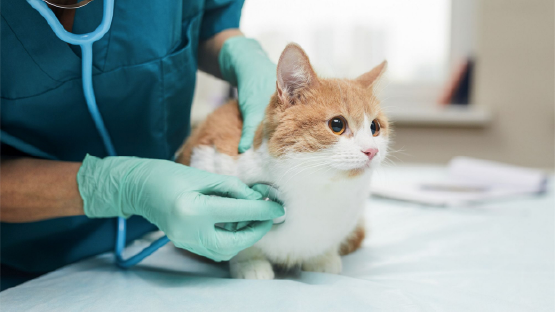
To be started as early as the 8th or 9th week of age by the veterinarian, vaccination is meant to boost the kitten’s immune defense system. It is imperative to stick to the immunization schedule established by the veterinarian.

To fight against infestation by internal parasites, the gestating female is wormed at the moment of giving birth. Then, the kitten must be wormed very regularly throughout his growth according to the veterinarian’s advice.

External parasites such as fleas and lice are also highly detrimental to the young cat’s health. An antiparasitic dispensed by the veterinarian will allow treating the kitten once he has reached 2 months of age.